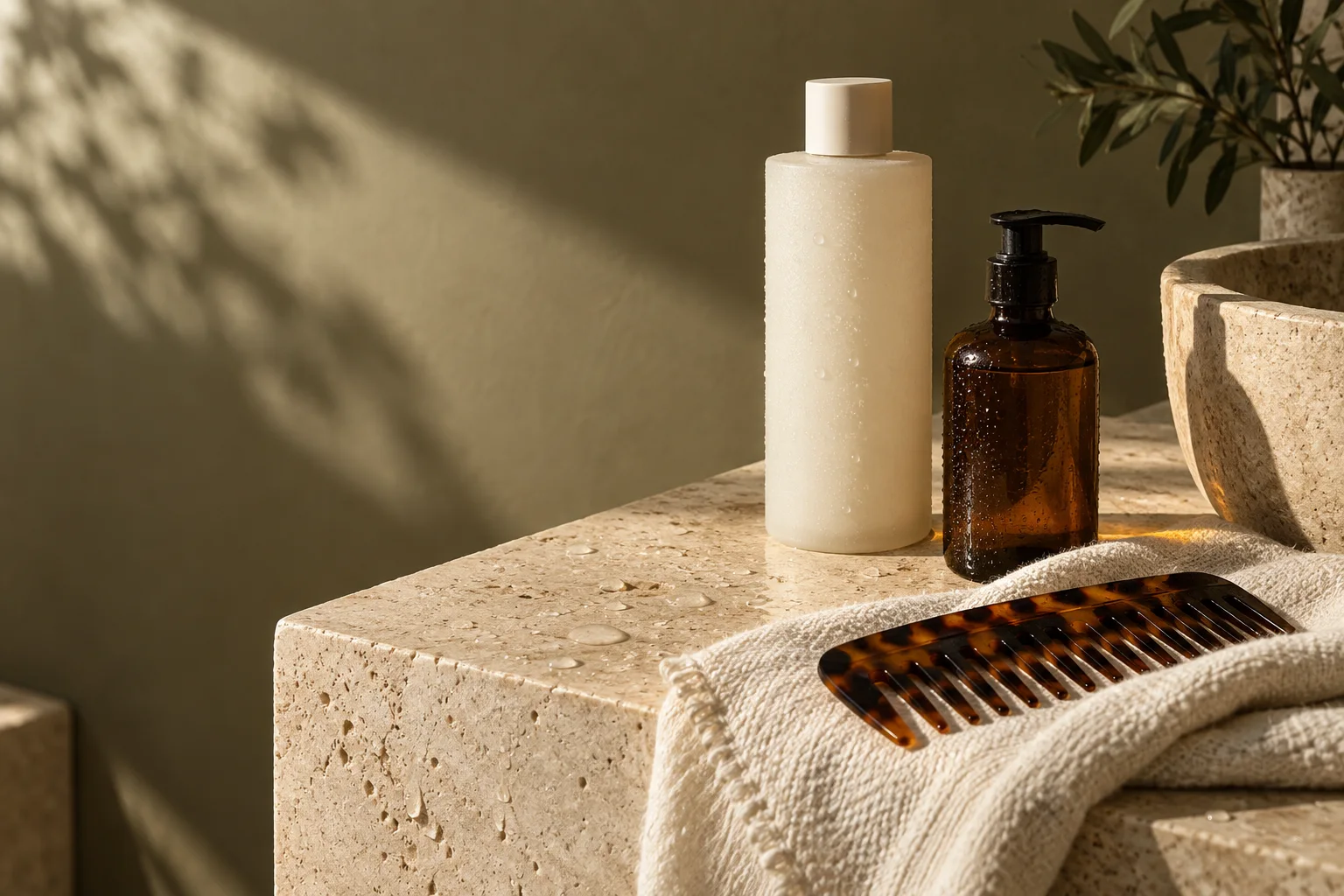
Think in two zones: choose cleansing around your scalp, and conditioning around your lengths. A product does not need to do every job.
Start with an observation, not a shopping list
A routine is easier to understand when you can say what you want it to do. “My hair is bad” gives you very little to work with. “My roots feel oily before my ends feel ready for another wash” is a much more useful observation. It separates two experiences without pretending to diagnose either one.
Before changing anything, write down the products you already own, where you apply them and what you want to be different. You may discover that you are looking for a different way to use a product, rather than a replacement for everything.
Give each zone a job
The American Academy of Dermatology recommends concentrating shampoo on the scalp. It also distinguishes conditioner placement by hair type: people with fine or straight hair may focus on the ends, while dry or curly hair may need conditioner through the lengths. Its guidance emphasises choosing products for your hair type, rather than one universal routine. Read the AAD guidance.
Make a small routine map
Draw two columns headed “scalp” and “lengths”. Under each, list the product, the amount you normally use and the label directions. Circle any item whose purpose you cannot explain. That is your first candidate to reconsider.
For example, if you own three finishing products but use them together every time, you cannot easily tell which one changes the result. Keeping the routine understandable makes future purchasing decisions easier.
A better question at the shelf
Instead of asking whether a range is “the best”, ask whether the particular product solves the job on your list, suits your routine and fits your budget. Matching bottles are optional; an understandable reason for buying each one is more valuable.
Persistent itching, pain, flaking or unusual hair loss needs individual assessment. A shopping guide cannot establish the cause. Our routine planner offers general organisation, not treatment advice.
Sources & editorial notes
- American Academy of Dermatology — Tips for healthy hair ↗
Clinical education; source for cleansing and conditioner placement.
Prepared with AI assistance and checked against the listed sources. This is not a hands-on product review or a dermatologist-reviewed article. Last substantive review: September 12, 2026.